

Malaysia v2: Introduction and workflows
The two Malaysia e-invoicing solutions in API v2 (legacy), LHDN and Peppol, and the B2B and B2C workflows for LHDN e-invoices.
Complyance offers two e-invoicing solutions for businesses in Malaysia:
- Peppol solution: send and receive e-invoices over the Peppol network, in a standard format that meets international standards.
- Non-Peppol (LHDN) solution: e-invoicing for businesses that must comply with the rules of Malaysia’s Inland Revenue Board (LHDN).
LHDN B2B workflow

This workflow covers issuing and managing B2B e-invoices in Malaysia under LHDN (Lembaga Hasil Dalam Negeri) rules: issuing, validation, storage and notifications between suppliers, buyers and the IRBM system.
The LHDN B2B e-invoicing API automates e-invoicing between suppliers, buyers and LHDN. Invoices are issued, validated, shared and stored through the IRBM Cloud and database.
The main parties in this flow are:
- Supplier: issues invoices, credit and debit notes, and refund notes.
- Buyer: receives and manages the invoice, and can request a cancellation.
- IRBM Cloud: stores and processes invoices.
- IRBM Database: stores validated invoices for record-keeping.
LHDN B2C workflow
This workflow shows how B2C e-invoices are issued and managed from a point-of-sale (POS) machine, through the compliance cloud platform and LHDN.
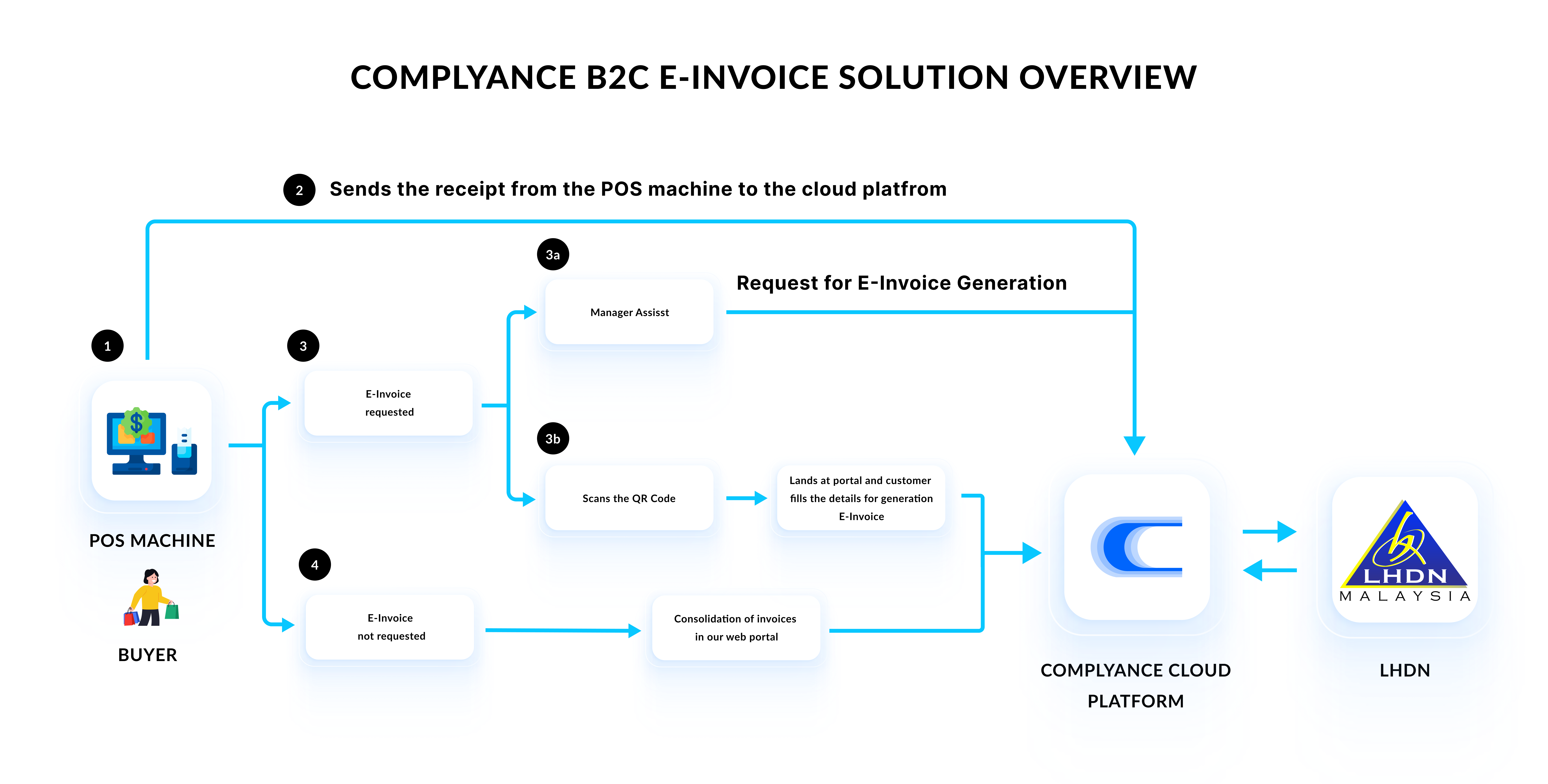
1. POS machine receipts
- The buyer makes a purchase and receives a normal receipt from the supplier’s POS machine, as in current business practice.
- No e-invoice is needed at this step.
2. Sending receipts to the cloud
- The POS machine sends the receipt details to the compliance cloud platform, which can later generate an e-invoice from them.
3. E-invoice requested later
- Step 3a: the buyer can request an e-invoice later. The request goes to Manager Assist.
- Step 3b: the buyer can also scan a QR code on the receipt to request an e-invoice.
The request goes to the compliance cloud platform, which directs the buyer to a portal to fill in the details for the e-invoice.
4. E-invoice requested at once
- Step 4a: if the buyer needs an e-invoice straight away, they open a link sent by SMS to their registered phone number. The cloud platform processes this request too.
5. No e-invoice needed
- If the buyer does not request an e-invoice, the process ends and the receipt stands as usual.
6. Supplier monthly consolidation
- The supplier consolidates all receipts monthly, ready to submit to LHDN.
7. E-invoice validation
- The supplier issues a consolidated e-invoice in XML or JSON and submits it to LHDN through the compliance cloud platform.
- LHDN validates the transactions against its rules.
With this flow, suppliers and buyers comply with LHDN’s e-invoicing rules, and buyers can still ask for an e-invoice at once or later.